


Informatics and Digital Skills

Theory: 3 hours/week | Practicals: 1 hour/week | ECTS Units: 5
Learning outcomes
During the three hours/week lectures and the two hours of laboratory work of the course the students become familiar with the way computers work, the basic principles of Linux, programming and practice on computer applications necessary for a Bioscientist.
Students are also taught material related to Teaching technologies and the accompanying didactic methodology and practicals of teaching.
Syllabus
1st section – Hardware and software – Office
- The basic parts of a computer (memory, CPU, I/O).
- Data storage, web.
- Familiarizing with Office: Word and Excel.
2nd Section – Linux
- Introduction to the Ubuntu – Linux operating system
- Linux commands (i): the system
- Linux commands (ii): file and directory management
- Linux commands (iii): motif search
3rd Section – Awk
- Introduction to Awk (i): Syntax – variables – mathematical functions – string manipulation.
- Introduction to Awk (ii): If statements – loops.
- Examples of programming with linux and awk for data handling and formating.
4th Section – Teaching abilities and new digital technologies
- Teaching technology (i)
- Teaching technology and practicals in teaching.
- Summarizing – Questions/discussion and answers on the material of the course.
Practicals/exercises
- Familiarization with the Linux system.
- Linux and awk commands.
Student performance evaluation
Grades are determined by the results in the final examination or by the two interim exams during the semester.
Suggested bibliography
- LINUX ΓΙΑ ΠΡΩΤΑΡΗΔΕΣ, DEE-ANN LEBLANC, RICHARD K. BLUM
- Linux το Γλωσσάρι, Granneman Scott
Teaching Material / E-class
Lecturers
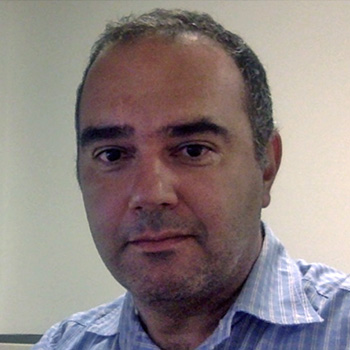
Grigorios Αmoutzias
(Course Coordinator)