



Enzymology

ΒΒ0303 | ECTS: 6
Theory: 4 hours/week | Practicals: 3 hours/week
Learning Outcomes
The main goal of this course is for the students to understand the basic principles of enzymology. More specifically, the course aims for students to comprehend the importance of enzymes as biological catalysts, the regulation of enzyme function and the variety of applications enzymes have in research in the biological sciences, health and industry, as well as their contribution to overall improvement of the standard of living.
An important aspect in achieving these goals is the participation in the laboratory practicals, the written reports of the laboratory practicals, as well as the oral presentation of research papers on topics relevant to the course’s syllabus.
Upon successful completion of the course, students will be able to:
- Classify enzymes and place them within the context of biochemical pathways and cellular processes.
- Explain the molecular mechanisms of enzyme catalysis and the regulation of enzyme activity in both simple and complex biological systems, from the cellular to the organismal level.
- Analyze the relationship between enzyme dysfunction and pathological conditions, including disease states.
- Apply principles of enzymology to practical problems in fields such as Biotechnology and Medicine.
- Propose potential enzyme-based applications, including the modification of enzymes in microorganisms of biotechnological interest, their use in industrial processes, and the targeting of enzymes involved in disease development.
Analytical Description of the Course
Detailed course outline:
- Introduction & Historical Overview: Introductory concepts; historical milestones in enzyme research
- Enzyme Structure: Primary, secondary, tertiary, quaternary structures; active sites
- Enzyme Purification: Methods for enzyme isolation and purification; chromatography, electrophoresis, ultrafiltration
- Enzyme Kinetics I: Basic principles; Michaelis-Menten kinetics
- Enzyme Kinetics II: Advanced kinetic models; multi-substrate reactions; inhibition
- Mechanisms of Enzyme Action: Catalytic strategies; transition state stabilization; cofactors
- Regulation of Enzyme Activity: Allosteric regulation; covalent modification; feedback control;
- Enzymes in Organized Systems: Localization; compartmentalization; pathway integration
- Enzymes in the Cellular Environment: Cellular conditions; protein–protein interactions; enzyme complexes
- Enzyme Degradation: Proteolysis; ubiquitin-proteasome system; lysosomal pathways
- Enzymes with Clinical & Biotechnological Relevance: Diagnostic, therapeutic, industrial, and environmental enzymes
- Enzyme Technology & Engineering: Protein engineering; directed evolution; immobilization; high-throughput screening
- Course Integration & Summary: Comprehensive review; case studies; Q&A; final assessment preparation
Laboratory Exercises
The students are trained in a series of laboratory practicals that aim to the purification and the basic biochemical characterization of invertase from yeast extracts. More specifically, the practicals include:
Week 1: Extraction and Partial Purification
Objectives:
• Learn techniques for extracting enzymes from yeast cells.
• Perform partial purification to enrich invertase.
Activities:
• Cell disruption (mechanical or chemical).
• Preparation of crude extract.
• Ammonium sulfate and ethanol precipitation, and other basic fractionation methods.
• Measurement of total protein concentration (Bradford assay).
Week 2: Determination of Enzymatic Activity
Objectives:
• Measure the enzymatic activity of invertase in crude and partially purified fractions.
Activities:
• Incubation of invertase with sucrose substrate.
• Detection of glucose and fructose products (coupled enzyme assay).
• Calculation of specific activity.
Week 3: Protein Purification Techniques
Objectives:
• Learn chromatographic separation and protein analysis techniques.
Activities:
• DEAE-cellulose column chromatography: ion-exchange separation of invertase.
• Collection of fractions and measurement of enzyme activity in each fraction.
Week 4: Protein Analysis & Kinetics
Objectives:
• Analyze purity of invertase and study its kinetic properties.
Activities:
• Protein electrophoresis (SDS-PAGE) to assess purity (demonstration).
• Determination of kinetic parameters (Vmax, KM) using varying sucrose concentrations.
Student Performance Evaluation
Students are assessed through a written examination covering the theoretical part of the course during the designated examination periods, with a passing threshold of 5/10. The overall course grade is calculated as the sum of the written examination (80%) and the laboratory report (20%), provided the written examination is passed. An optional assignment is graded with one (1) point (1/10) and is added to the total grade of the sum of the written examination and the laboratory report.
Reading Suggestions
- Price N. και Stevens L. Βασικά Στοιχεία Ενζυμολογίας. 2014. Εκδόσεις Παρισιάνου.
- Berg J.M., Tymoczko J.L., Stryer L. ΒΙΟΧΗΜΕΙΑ. 5η έκδοση, 2002. Πανεπιστημιακές Εκδόσεις Κρήτης.
- Γεωργάτσος ΙΓ. Ενζυμολογία. 1991. Εκδόσεις Γιαχούδη-Γιαπούλη.
- Κλώνης Ι. Ενζυμολογία. 2018. Εκδόσεις ΕΜΒΡΥΟ
- Κλώνης Ι. Ενζυμική Βιοτεχνολογία. 4η Εκδοση, 2020. Πανεπιστημιακές Εκδόσεις Κρήτης
Teaching Material / E-class
Lecturers
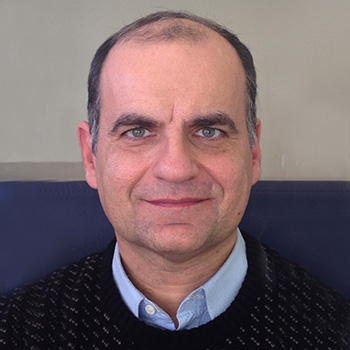
Nikolaos Balatsos(Course Coordinator)

Vasiliki Skamnaki